

Pregnancy and childbirth are natural processes, and most women hope for a safe and uncomplicated vaginal delivery. However, sometimes labour does not progress normally because the baby is unable to pass through the birth canal despite adequate uterine contractions. This condition is known as obstructed labour.
Obstructed labour is an important obstetric emergency because delayed diagnosis and treatment can put both the mother and baby at serious risk.
Importantly, not every prolonged labour is obstructed labour. Some labours progress slowly but safely, while others may stop because of a mechanical obstruction. Recognising the difference requires careful assessment by an experienced obstetrician.
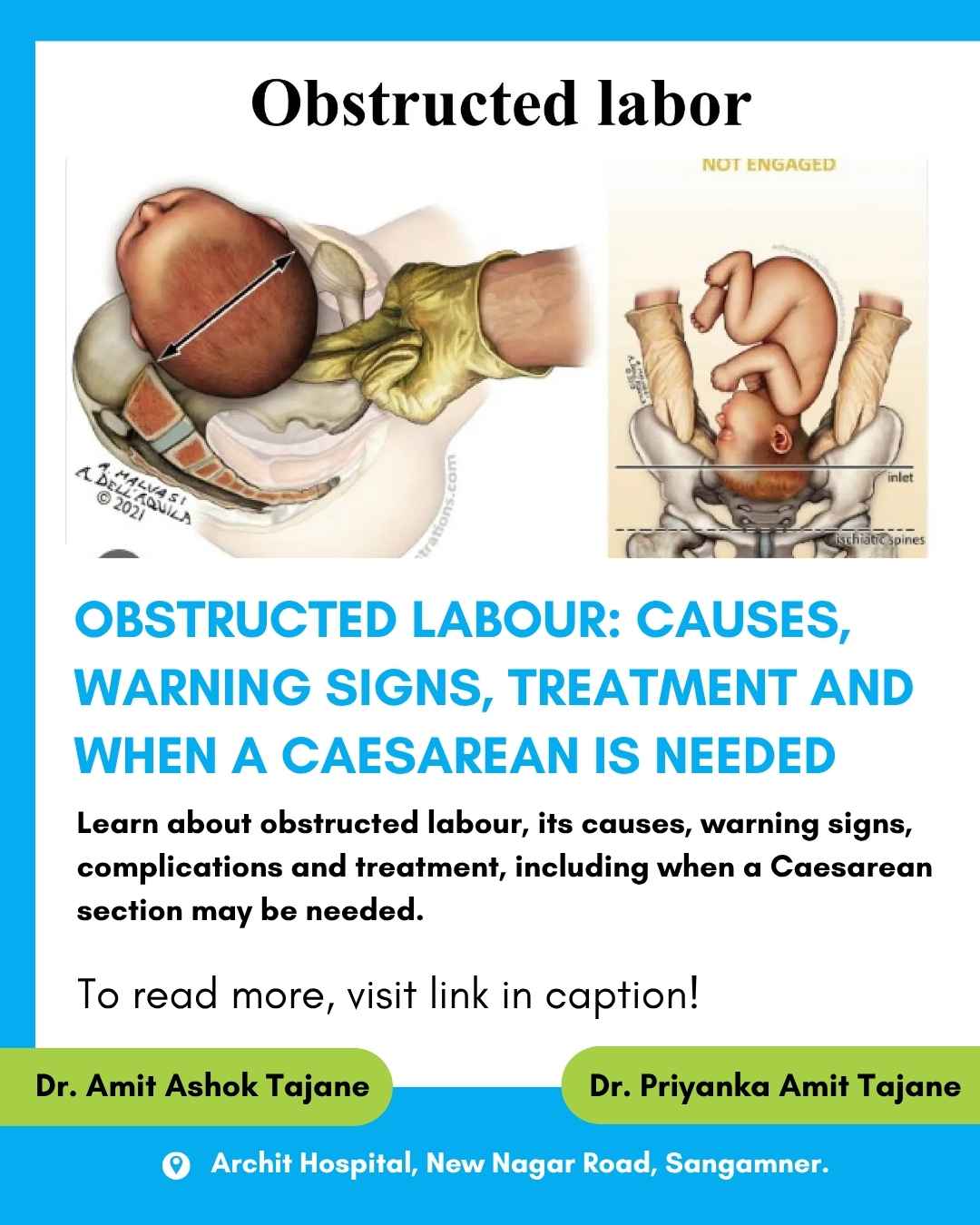
Obstructed labour occurs when the baby cannot descend through the mother’s birth canal because of a physical or mechanical obstruction.
In simple terms, the uterus may continue to contract strongly, but the baby is unable to move down and the labour fails to progress.
The obstruction may occur because:
- The baby’s head is too large in relation to the mother’s pelvis
- The baby’s position is abnormal
- The baby’s presentation is unsuitable for vaginal delivery
- There is an abnormality of the maternal pelvis
- A pelvic mass or fibroid is obstructing the birth canal
- There is a combination of maternal and fetal factors
If the obstruction is not recognised in time, prolonged pressure and strong uterine contractions can cause serious complications.
No.
This is an important distinction for expecting mothers and their families.
Labour can sometimes be slow because contractions are not strong enough, the cervix is taking longer to dilate, or the baby’s position is taking time to adjust.
In contrast, obstructed labour involves a mechanical problem that prevents the baby from descending despite adequate contractions.
Therefore, doctors do not decide about Caesarean delivery simply based on the number of hours a woman has been in labour.
They assess several factors, including:
- Cervical dilatation
- Strength and frequency of contractions
- Baby’s position
- Baby’s presentation
- Descent of the baby’s head
- Fetal heart rate
- Mother’s general condition
- Evidence of maternal-fetal disproportion
This careful assessment helps determine whether labour can safely continue or whether intervention is required.
There are several possible causes.
- Cephalopelvic Disproportion (CPD)
Cephalopelvic disproportion occurs when the baby’s head or body cannot pass safely through the mother’s pelvis.
This may happen when:
- The baby is relatively large
- The maternal pelvis is relatively narrow
- The baby’s head is in an unfavourable position
- A combination of these factors is present
However, an important point is that an ultrasound estimate of a large baby does not automatically mean that a Caesarean section is required.
The actual progress of labour and fetal descent are also important.
- Abnormal Position of the Baby
The baby’s head may be down, but the position of the head may make descent difficult.
For example:
- Occipito-posterior position
- Persistent transverse position
- Deep transverse arrest
In some cases, the baby may eventually rotate and vaginal delivery may still be possible.
In other situations, the position may not correct and intervention may become necessary.
- Abnormal Presentation
Normally, the baby’s head presents first.
However, certain presentations can make vaginal delivery difficult or unsafe.
These include:
- Transverse lie
- Some breech presentations
- Brow presentation
- Certain face presentations
A transverse lie, for example, means that the baby is lying sideways rather than vertically and vaginal delivery is generally not possible.
- A Large Baby
A baby with a high birth weight may have difficulty passing through the maternal pelvis.
The likelihood of a large baby can increase in conditions such as maternal diabetes.
However, estimated fetal weight is only one part of the decision-making process. Ultrasound weight estimates are not perfectly accurate, and the decision regarding mode of delivery should be individualised.
- Abnormalities in the Mother’s Pelvis
Rarely, the pelvis or surrounding structures may create an obstruction.
Possible causes include:
- Certain pelvic abnormalities
- Large fibroids
- Pelvic masses
- Structural abnormalities
These conditions may interfere with the baby’s descent.
Obstructed labour is diagnosed through clinical assessment rather than by one symptom alone.
During labour, an obstetrician may become concerned when:
Labour is not progressing
The cervix does not dilate as expected despite adequate contractions.
The baby’s head is not descending
The baby’s head remains high or fails to move down despite ongoing contractions.
Excessive moulding of the baby’s head occurs
Some moulding of the baby’s skull bones can occur during normal labour. Excessive moulding, however, can suggest difficulty in passage through the pelvis.
The mother becomes exhausted
Prolonged labour can result in severe fatigue, dehydration and metabolic disturbances.
The baby’s heart rate becomes abnormal
Changes in the fetal heart rate can indicate that the baby may not be tolerating labour well.
These findings need immediate assessment because continued labour may not always be safe.
Management depends on the cause, the stage of labour, and the condition of both mother and baby.
Step 1: Assess the Mother
The obstetric team evaluates:
- Blood pressure
- Pulse
- Temperature
- Hydration
- Urine output
- Vaginal bleeding
- Signs of infection
- General clinical condition
Step 2: Assess the Baby
The baby’s condition is assessed by checking:
- Fetal heart rate
- Presentation
- Position
- Head descent
- Amniotic fluid
- Presence of meconium, when relevant
Continuous or appropriately timed fetal monitoring may be required depending on the clinical situation.
Step 3: Assess Labour Progress
The doctor assesses cervical dilatation and fetal descent over time.
Modern labour management focuses on the overall clinical picture rather than relying on a rigid time limit for every woman.
The key question is:
“Is labour progressing safely?”
Step 4: Identify the Cause
The next step is to understand why labour is not progressing.
Is it because:
- Contractions are inadequate?
- The baby’s position is unfavourable?
- There is a mismatch between the baby and pelvis?
- There is fetal distress?
- There is another mechanical obstruction?
The answer determines the next step.
Not necessarily.
This is one of the most common misconceptions.
If labour is progressing slowly but there is no evidence of mechanical obstruction, and both mother and baby are stable, the obstetrician may recommend continued observation or appropriate interventions to support labour.
In selected cases, labour augmentation may be considered.
However, augmentation should not be used simply to force labour through a mechanical obstruction.
If there is clear evidence of cephalopelvic disproportion or another significant obstruction, increasing uterine contractions may actually increase the risk of complications.
This is why proper assessment by an obstetrician is essential before deciding how to proceed.
A Caesarean section may be recommended when vaginal delivery is no longer considered safe or feasible.
Some important situations include:
- Confirmed or strongly suspected mechanical obstruction
If the baby cannot safely pass through the birth canal, Caesarean delivery may be necessary.
- Failure of labour to progress
If adequate contractions are present but the cervix or baby’s descent is not progressing appropriately, and obstruction or disproportion is suspected, Caesarean delivery may be required.
- Fetal distress
If the baby’s heart rate indicates significant fetal compromise and a safe vaginal delivery cannot be achieved quickly, an emergency Caesarean may be necessary.
- Unfavourable presentation or position
Certain fetal presentations and positions may make vaginal birth unsafe.
- Suspected uterine rupture
This is a life-threatening emergency that requires immediate treatment.
The decision for Caesarean delivery should therefore be based on the clinical condition of the mother and baby rather than simply on the duration of labour.
Delayed treatment can result in serious complications for both mother and baby.
Complications for the Mother
Uterine rupture
Persistent obstruction combined with strong uterine contractions can put extreme stress on the uterus and, in severe cases, lead to uterine rupture.
Severe bleeding
Major haemorrhage can occur, particularly if uterine rupture or significant birth trauma develops.
Infection and sepsis
Prolonged labour, particularly when the membranes have been ruptured for a long time, can increase the risk of infection.
Severe exhaustion and dehydration
A prolonged labour can leave the mother extremely exhausted and dehydrated.
Injury to the bladder or surrounding tissues
Severe and prolonged obstruction can cause pressure-related injury to pelvic tissues and, in neglected cases, urinary or bowel fistulae.
One of the major concerns in obstructed labour is reduced oxygen supply to the baby.
Possible complications include:
- Fetal distress
- Birth asphyxia
- Meconium-related complications
- Birth trauma
- Need for neonatal intensive care
- Neurological injury in severe cases
- Stillbirth in extreme, untreated situations
This is why timely recognition of abnormal labour is so important.
Pregnancy and childbirth are natural, but they are not always predictable.
A labour that initially appears normal can change rapidly.
The role of an experienced obstetrician is not simply to perform Caesarean sections.
The real skill lies in identifying:
- When normal vaginal delivery is likely to be safe
- When labour needs more time
- When labour augmentation may be appropriate
- When instrumental delivery may be possible
- When continued labour could become dangerous
- When Caesarean delivery is the safer option
The aim is not to perform a Caesarean unnecessarily.
The aim is to choose the safest mode and timing of delivery for the mother and baby.
Not every case can be predicted or prevented.
However, good antenatal care can help identify several risk factors before labour begins.
Regular pregnancy check-ups can help assess:
- Maternal health
- Blood pressure
- Blood sugar
- Baby’s growth
- Baby’s presentation
- Placental location
- Amniotic fluid
- Previous Caesarean or difficult delivery
- Other high-risk pregnancy factors
Women with diabetes, a previous difficult delivery, suspected large baby, multiple pregnancy, previous Caesarean section or other high-risk factors may require an individualised delivery plan.
During labour, immediate medical evaluation is important if there is:
- Severe or continuous abdominal pain
- Vaginal bleeding
- Reduced or absent fetal movements
- Abnormal fetal heart rate
- Labour that is not progressing
- Severe maternal exhaustion
- Fever or signs of infection
- Prolonged rupture of membranes
- Any concern raised by the treating doctor
Do not wait for the pain to become unbearable before seeking help.
It is a situation in which the baby is unable to descend through the birth canal because of a mechanical problem.
Early recognition is crucial.
The right decision may sometimes be to continue labour with careful monitoring. In other situations, intervention or Caesarean delivery may be necessary.
The safest approach is not to focus only on avoiding a Caesarean section or achieving a normal delivery.
The goal should always be:
A healthy mother and a healthy baby.
If you are pregnant or approaching your delivery date, discuss your individual delivery plan with your obstetrician, particularly if you have a previous Caesarean, suspected large baby, diabetes, abnormal fetal position or any other high-risk pregnancy factor.
For expert obstetric care and guidance regarding pregnancy and childbirth, consult Dr. Amit Tajane at Archit Hospital, Sangamner.
Medical Disclaimer: This article is intended for general educational purposes and does not replace an examination, diagnosis or personalised medical advice from a qualified obstetrician. Every labour is different, and decisions regarding vaginal delivery, assisted delivery or Caesarean section should be made based on the individual clinical situation.
Address
1st floor, Madhukunj Complex,
Link Road, New, Navin Nagar Rd,
Sangamner, Maharashtra 422605
dr.tajaneamit@gmail.com
Phone Number
+91-8668617773
Meet the Doctors
Empowering Women's Health with Expert Care

Laparoscopic Gynecologist & Fertility Expert
MBBS, DGO (Obs & Gyne)
Fellowship in Assisted Reproductive Treatments (Israel)
Fellowship in Gynecologic Endoscopy (Germany)

Clinical Embryologist
Our Achievements
Laparoscopic Surgeries
Years of Experience
Babies Delivered
नवीन जीवनाची सुरुवात...
Our Services
Comprehensive health care for women of all age group

Maternity Care
Providing comprehensive and nurturing care throughout your pregnancy journey.

Gynecologic Treatments
Expert care for all gynecological issues, tailored to women of all ages.
Laparoscopic Surgeries
Advanced minimally invasive surgeries for precise and effective treatment.
Infertility Diagnosis
Thorough and compassionate diagnosis to help you on your path to parenthood.